Efficiency and Exchange
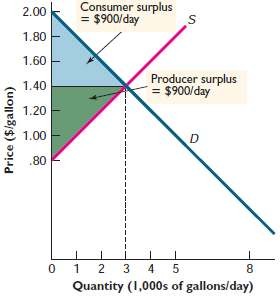
Pareto efficiency is a state where there is no opportunity for exchange or trade that will make at least one person better off without harming others. Pareto efficiency occurs when market is at equilibrium. When the market is out of equilibrium, it is always possible to make a Pareto- improving transaction, one that benefits at least one person without harming others.
Ø Price Ceilings

A price ceiling is a government imposed limit on the price of a product/service.
Under perfect competition, the market of milk reaches equilibrium at $1.4/litre, this results in maximum economic surplus of $1800. However, with a price ceiling of $1, producers will only supply 1000 litres so their surplus is reduced to $100. Also with the low supply, only those with willing to pay $1.80 or more can afford milk. The total lost in surplus is $800
Ø Price Subsidies


Subsidy is when government pays the producers directly so that consumers can purchase the product at a lower cost.
Normally, the consumers in this country will receive $4,000,000 surplus per month. Since the country can import as much milk as it wants, the supply is perfectly elastic. With a $1/litre subsidy, the price consumer pays for a litre of milk drops to $1, which leads to a total of 6 million litres consumed per month. Seemingly, consumer surplus would have increased by $5,000,000 However, the cost of subsidy is paid for by taxpayers and its equal to $6,000,000 per month, so economic surplus has actually reduced by $1,000,000
Taxes and Efficiency
Governments often impose taxes on sellers and businesses but it can inadvertently affect buyers too.
E.g. consider the market for hamburgers shown below; what is the effect of a $1 tax on sellers?

The equilibrium price increased by $0.50, since the $1 tax is essentially an increase in marginal cost. Therefore, although only sellers were taxed, buyers now have to pay $0.50 more for a burger and supplier’s pay $0.5 more to make a burger. The tax also reduces the economic surplus, as the size of the triangle decreased. The area would have decreased from $9000 to $6250 but they also pay $2500 les tax elsewhere so the total loss in surplus is $250. This is known as the deadweight loss, the reduction in total economic surplus that arise when a market does not operate where marginal cost equal to marginal benefit. The rectangle represents tax revenue.
Taxes, Elasticity and Efficiency
In general, for goods with smaller the price elasticity of demand or supply for a good, the smaller is the deadweight loss from a tax imposed on seller of that good. E.g. salt is inelastic so, if a 50% tax was placed upon it people would still buy it so there is minimal loss of surplus. Therefore, it is more efficient to tax sellers for goods with lower price elasticity of demand or supply

E.g. consider the deadweight loss in the following two markets with different elasticity of demand
In both markets, the original equilibrium is the same. However, the demand in (b) is more inelastic than (a) since its gradient is larger. So with tax, the deadweight loss represented by the triangle is:
A(a) = 0.5 ´ 1 ´ 5 = $2.5
A(b) = 0.5 ´ 1 ´ 3 = $1.5
So the good with a less elastic demand has less deadweight loss as a result of tax